ClickHouse meets SeaORM: Arrow-powered data pipeline


sea-clickhouse is a ClickHouse client that integrates with the SeaQL ecosystem. It is a soft fork of clickhouse-rs: 100% compatible with all upstream features, with SeaQL's dynamic type and Arrow support added on top. The fork is continually rebased on upstream.
In this blog post we cover:
- Dynamic rows with
try_get: fetch query results without defining any schema struct - Arrow RecordBatch streaming: stream query results as
RecordBatches and insert them back into ClickHouse - SeaORM to ClickHouse: convert SeaORM entities to Arrow and insert into ClickHouse
- Arrow Schema to ClickHouse DDL: derive
CREATE TABLEDDL from an Arrow schema, no hand-written SQL
Quick Install
[dependencies]
# a drop-in replacement of clickhouse
sea-clickhouse = { version = "0.14", features = ["arrow", "chrono", "rust_decimal"] }
Ergonomic dynamic column type with try_get
The native clickhouse-rs client requires you to define a #[derive(Row)] struct whose field types match the query output exactly:
#[derive(Row, Deserialize)]
struct Reading {
    #[serde(with = "special_deserializer")] // or use a custom deserializer?
    temperature: f64, // f32? f64? depends on the SQL expression
}

let mut cursor = client.query("SELECT ...").fetch::<Reading>()?;
If the struct says f32 but the server returns Float64, you get a runtime deserialization error. For computed columns, ad-hoc queries, or SELECT * on evolving tables, maintaining these structs is fragile.
sea-clickhouse reads the column types from the response metadata and maps them to sea_query::Value automatically:
let mut cursor = client.query("SELECT 1::UInt32 + 1::Float32 AS value").fetch_rows()?;
let row = cursor.next().await?.expect("one row");

// UInt32 + Float32 -> Float64
assert_eq!(row.try_get::<f64, _>(0)?, 2.0);           // by index
assert_eq!(row.try_get::<f32, _>(0)?, 2.0);           // narrower type also works
assert_eq!(row.try_get::<Decimal, _>("value")?, 2.into()); // by column name
try_get coerces at runtime: access by index or column name, request the type you need, and it converts where possible.
Arrow RecordBatch Streaming
next_arrow_batch(chunk_size) streams query results as Arrow RecordBatches, ready for DataFusion, Polars, Parquet export, or any Arrow consumer.
use clickhouse::Client;
use sea_orm_arrow::arrow::{array::RecordBatch, util::pretty};

let client = Client::default().with_url("http://localhost:18123");

let sql = r#"
    SELECT
        toUInt64(id)                   AS id,
        toDateTime64(recorded_at, 6)   AS recorded_at,
        toInt32(sensor_id)             AS sensor_id,
        toFloat64(temperature)         AS temperature,
        toDecimal128(voltage, 4)       AS voltage
    FROM sensor_data
    LIMIT 1000
"#;

let mut cursor = client.query(sql).fetch_rows()?;
let mut batches: Vec<RecordBatch> = Vec::new();
while let Some(batch) = cursor.next_arrow_batch(100).await? {
    batches.push(batch);
}
pretty::print_batches(&batches).unwrap();
+----+-------------------------+-----------+----------------------+---------+
| id | recorded_at             | sensor_id | temperature          | voltage |
+----+-------------------------+-----------+----------------------+---------+
| 1  | 2026-01-01T13:35:36.736 | 106       | 36.345616831016436   | 3.2736  |
| 2  | 2026-01-01T10:07:38.458 | 108       | 10.122001773336567   | 3.3458  |
| 3  | 2026-01-01T01:15:18.518 | 108       | 35.21406789966149    | 3.1518  |
| 4  | 2026-01-01T05:36:57.017 | 107       | 22.92828141235666    | 3.2016  |
| 5  | 2026-01-01T13:17:36.056 | 106       | -2.082591477369223   | 3.0056  |
| ...                                                                       |
+----+-------------------------+-----------+----------------------+---------+
Those batches can be inserted back into ClickHouse directly:
let mut insert = client.insert_arrow("sensor_data_processed", &batches[0].schema()).await?;
for batch in &batches {
    insert.write_batch(batch).await?;
}
insert.end().await?;
No #[derive(Row)] macros. The Arrow schema carries the type information end-to-end.
SeaORM to ClickHouse
SeaORM started as an OLTP toolkit, but with Arrow and now ClickHouse support, SeaQL bridges data engineering with data science: your OLTP entities become the source of truth for OLAP pipelines too.
use sea_orm::entity::prelude::*;

#[sea_orm::model]
#[derive(Clone, Debug, PartialEq, DeriveEntityModel)]
#[sea_orm(table_name = "measurement", arrow_schema)]
pub struct Model {
    #[sea_orm(primary_key)]
    pub id: i32,
    pub recorded_at: ChronoDateTime,
    pub sensor_id: i32,
    pub temperature: f64,
    #[sea_orm(column_type = "Decimal(Some((38, 4)))")]
    pub voltage: Decimal,
}
Build models, convert to a RecordBatch, and insert:
use sea_orm::ArrowSchema;

let models: Vec<measurement::ActiveModel> = vec![..];

let schema = measurement::Entity::arrow_schema();
let batch = measurement::ActiveModel::to_arrow(&models, &schema)?;

let mut insert = client.insert_arrow("measurement", &schema).await?;
insert.write_batch(&batch).await?;
insert.end().await?;
arrow_schema on the entity derives the Arrow schema at compile time. to_arrow converts a slice of ActiveModels into a RecordBatch. From there, insert_arrow streams the batch into ClickHouse over HTTP. See the full working example.
Arrow Schema to ClickHouse DDL
ClickHouseSchema::from_arrow derives a full CREATE TABLE statement from any Arrow schema, and exposes a SeaQuery-like fluent API to configure ClickHouse-specific attributes:
use clickhouse::schema::{ClickHouseSchema, Engine};

let mut schema = ClickHouseSchema::from_arrow(&batch.schema());
schema
    .table_name("sensor_readings")
    .engine(Engine::ReplacingMergeTree)
    .primary_key(["recorded_at", "device"]);
schema.find_column_mut("device").set_low_cardinality(true);

let ddl = schema.to_string();
client.query(&ddl).execute().await?;
Generated DDL:
CREATE TABLE sensor_readings (
    id UInt64,
    recorded_at DateTime64(6),
    device LowCardinality(String),
    temperature Nullable(Float64),
    voltage Decimal(38, 4)
) ENGINE = ReplacingMergeTree()
PRIMARY KEY (recorded_at, device)
The full workflow: Arrow -> derive DDL -> create table -> insert batches. Zero hand-written ClickHouse SQL. All examples shown here are available as runnable examples in the repository.
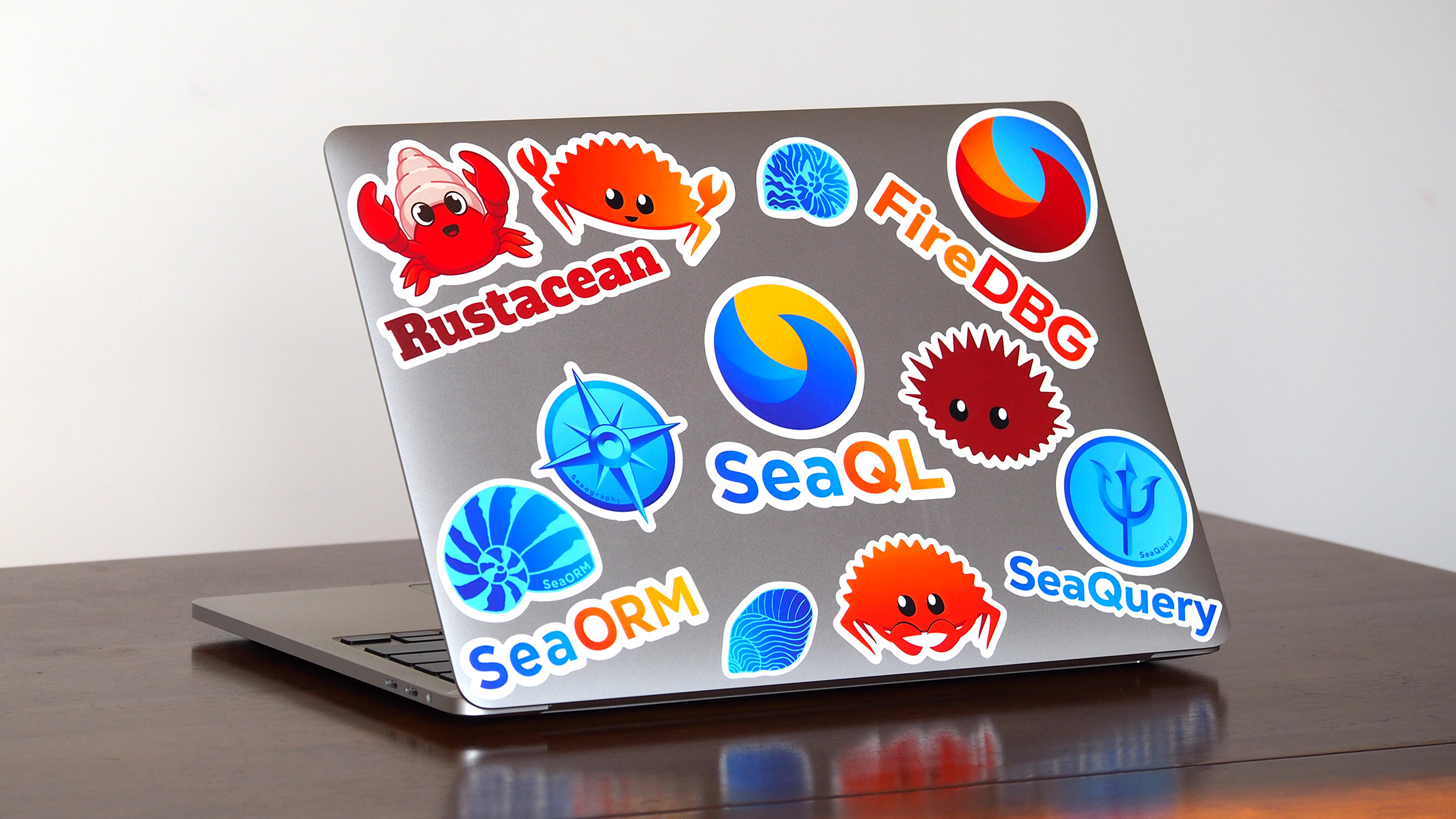
🦀 Rustacean Sticker Pack
The Rustacean Sticker Pack is the perfect way to express your passion for Rust. Our stickers are made with a premium water-resistant vinyl with a unique matte finish.
Sticker Pack Contents:
- Logo of SeaQL projects: SeaQL, SeaORM, SeaQuery, Seaography
- Mascots: Ferris the Crab x 3, Terres the Hermit Crab
- The Rustacean wordmark
Support SeaQL and get a Sticker Pack!